
The Lighthouses of Greece: Beacons of Maritime History
The Lighthouses of Greece: Beacons of Maritime History
Standing on rugged headlands, isolated rocky islets and harbour entrances, lighthouses are an inseparable part of the Greek coastal landscape. Behind their distinctive architecture lies a history shaped by seafaring, trade and the need to approach land safely.
For generations of sailors, recognising a coastline was a demanding task. A reef, a low headland or an indistinct harbour entrance could conceal serious dangers. A lighthouse provided a recognisable point in the darkness, helping crews establish their position and continue their passage.
Long before purpose-built lighthouses, fires lit on elevated ground helped sailors identify the shore. This need found its most celebrated expression in the Lighthouse of Alexandria, constructed in the third century BC on the island of Pharos. The island’s name became associated with the word for lighthouse in Greek and several other languages.
In Greece, the systematic development of the modern lighthouse network took place primarily during the nineteenth century. Expanding trade and shipping created a growing need to mark coastal routes and maritime passages. The organisation of the Greek Lighthouse Service in 1887 represented an important step towards the coordinated development of the network.
Advances in optical systems and rotating mechanisms also allowed lighthouses to acquire distinctive light characteristics. Each signal could serve as a recognisable identity for a particular point along the coast.
Hellenic Navy Lighthouse Service — History and Development
The People Behind the Light
The houses preserved beside historic lighthouse towers remind us that these structures were also places where people lived and worked. Their operation depended on lighthouse keepers, often stationed in isolated locations, far from settlements and convenient access.
Automation gradually changed this way of life. Maintaining the network, however, remains essential. Inspections, repairs and maintenance continue to be carried out by the personnel and technical teams of the Greek Lighthouse Service.
Hellenic Navy Lighthouse Service — Activities
Five Distinctive Landmarks
In the passage between Skiathos and the Pelion peninsula, Lefteris is associated with a story reaching back to antiquity. Herodotus records that the Persians erected a stone pillar on the reef known as Myrmex to identify the hazard. The ancient pillar and today’s beacon belong to different chapters in the navigational history of the same passage.
FL (2) WR 10s 12/8 M

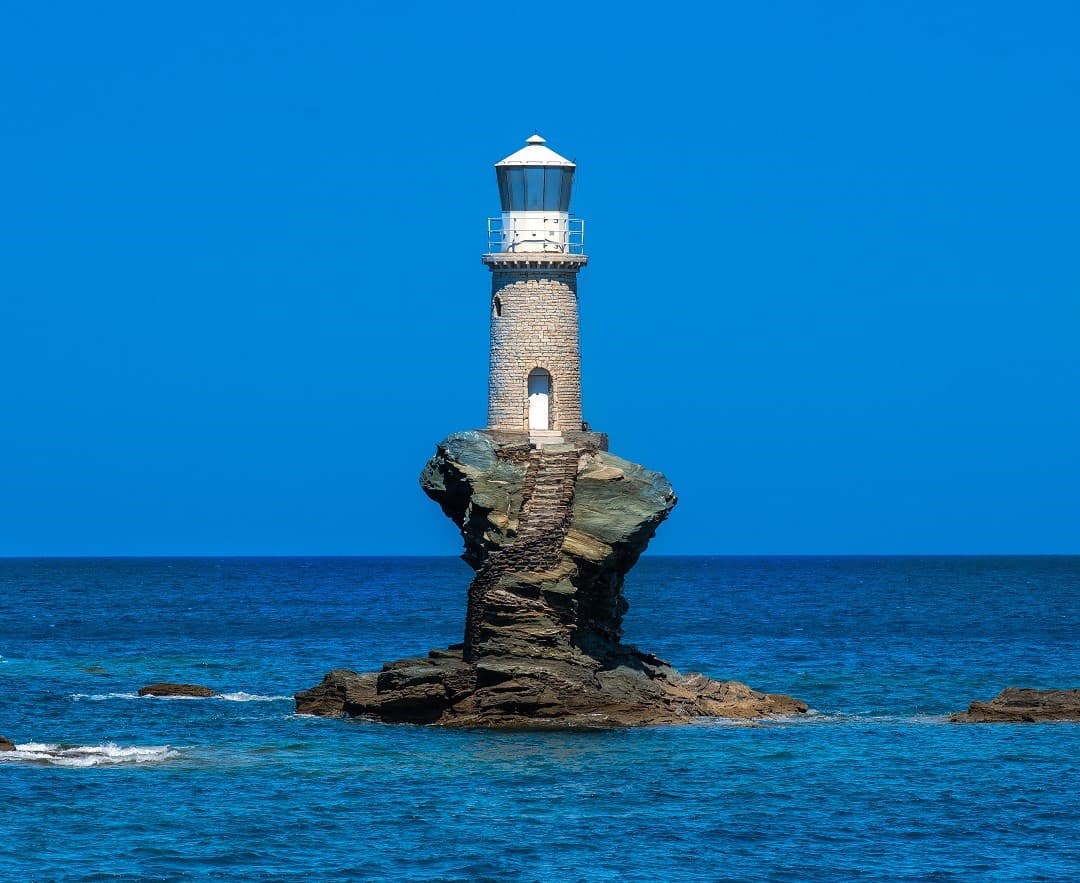
Tourlitis Lighthouse on Andros, built on a rock opposite the Venetian castle of Chora, is one of the island’s most recognisable landmarks. Destroyed during the Second World War, it was later reconstructed with funding from the Goulandris family.
FL (2) 15s 19m 11M

South Aegean Regional Tourism Guide — Tourlitis
At Cape Maleas, a square stone tower stands above the steep coastline of a historic maritime passage. Its restoration in 2009 preserved an important example of Greek lighthouse architecture.
FL 10s 40m 17M
Aikaterini Laskaridis Foundation Lighthouse Archive
The lighthouse at Cape Tainaro, also known as Cape Matapan, marks the southernmost point of mainland Greece. Its stone tower and keeper’s residence form an imposing architectural ensemble, closely connected to the geography of the headland.
FL (2) 20s 6M 22M
At Trikeri, overlooking the entrance to the Pagasetic Gulf, the lighthouse station dates to 1854. The square stone tower was added in 1918, reflecting successive stages in the development of the installation.
FL(3) 20s 22m 20M

The Lighthouses and Coastal Lights Along Our Spring Flotilla
During NorthSailing’s spring 2026 flotilla, we sailed past lighthouse sites and coastal lights that connected our journey with this maritime heritage:
- Atspas — Skala Marion, Thassos.
- Harbour light on Lemnos.
- Peristera, Lemnos .
- Coastal light in the Skyros area — Lithari / Myrmigi.
- Lefteris — the passage between Skiathos and Pelion.
- Trikeri — Cape Kavoulia, Pelion.
- Prasouda — off Kymi, Evia.
- Arapis — near Cape Kafireas, Evia.
- Tourlitis — Chora, Andros.
- Cape Maleas — Laconia.
- Cape Tainaro — southern Mani.
- Cape Neokastro — Pylos.
- Tsichli Baba, also known as Fanari — the entrance to Navarino Bay.
- Agios Andreas — Ithaca.
These lights once played a crucial role in helping sailors find their position and navigate safely. Today, although technology has transformed the way we travel, lighthouses retain their navigational and historical value. They remain emblematic features of the Greek coastline: recognisable symbols of the places where they stand and enduring witnesses to life at sea.
For our flotilla, passing these landmarks was an encounter with that continuity. Along the same headlands and through the same maritime passages, the lighthouses still connect today’s journeys with the generations of sailors who came before us.